COP31 fails to deliver key political deal, with fossil fuels, climate finance and scientific ambition fuelling deadlock
Share this page
By Rosita Zilli, Policy Director, and Clara Vullo, Policy Officer
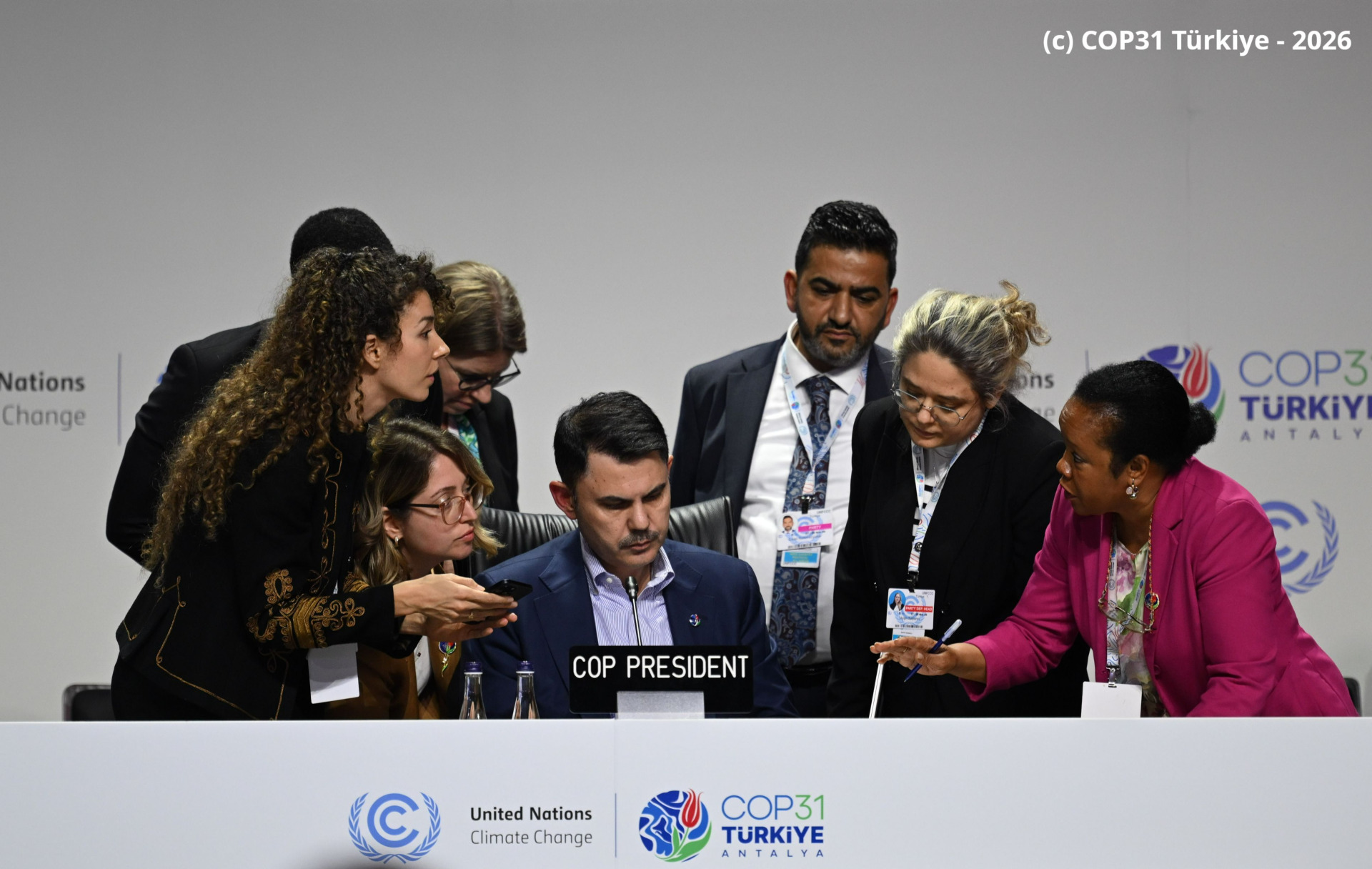
Billed as the COP of implementation, COP31 in Antalya closed on 22 November without agreement on its main political outcome, the cover decision, proposed by the Turkish and Australian presidencies as the Antalya Pact. Negotiations extended two days beyond their scheduled conclusion, making this the longest UN climate conference on record. The European Union, the United Kingdom and several other countries, including Norway and small island developing states particularly vulnerable to climate change, rejected the final draft over its failure to adequately address the transition away from fossil fuels, adaptation finance and the scientific basis for climate action. The breakdown marked the first time since Copenhagen in 2009 that a COP failed to adopt its overarching political agreement. Nevertheless, decisions were adopted on specific negotiating tracks, including the Just Transition Work Programme, the Global Goal on Adaptation and the Adaptation Fund. Other issues, including the Mitigation Work Programme, remained unresolved and will require further negotiations ahead of COP32 in Addis Ababa in November 2027.
A central point of contention was how to translate the COP28 commitment to transition away from fossil fuels in energy systems into concrete action. The final draft contained no explicit reference to fossil fuels, referring only indirectly to the COP28 agreement. Saudi Arabia and Russia resisted stronger language, while the EU and other countries objected to provisions promoting the expansion of carbon capture and storage to gigaton scale by 2035, concerned that this could weaken the emphasis on emissions reductions and prolong reliance on fossil fuels. Adaptation finance was another major source of disagreement. Despite the COP30 commitment to work towards tripling adaptation finance for developing countries, the proposed text failed to establish a clear baseline, milestones or sufficiently concrete assurances on delivery.
A further dispute concerned the scientific basis for the next global stocktake. Parties could not agree on a clear commitment to completing the next IPCC assessment in time to inform the 2028 review. These discussions took place against growing concern over the expected overshoot of the Paris Agreement's 1.5°C temperature goal, with current policies pointing towards approximately 2.8°C of warming by 2100.
In a joint declaration issued on 22 November, Irish Climate Minister Darragh O'Brien and European Commissioner Wopke Hoekstra expressed the EU's profound disappointment with the proposed agreement. They argued that it failed to respond adequately to climate science, made no explicit reference to fossil fuels and risked weakening the implementation of existing commitments. While reaffirming the EU's commitment to multilateralism, they stressed that consensus should not come at the expense of meaningful climate action and called for reflection on the effectiveness of the COP process.
Despite the failure to adopt the overarching political agreement, COP31 saw progress through voluntary international initiatives. The EU endorsed the 35-by-35 Global Electrification Pledge, launched by the Turkish Presidency following the Electrify Now campaign, which aims to raise electricity's share of global final energy consumption to 35% by 2035. Supported by more than 80 countries, the pledge reflects the growing importance of electrification in decarbonising energy systems, a priority also reflected in the EU's forthcoming Electrification Action Plan. The EU also joined initiatives including the Global Geothermal Ambition 2050, the Global SF6 Pledge and the Antalya Green Industrialisation Compact, aimed at supporting the clean energy transition and industrial decarbonisation.
EERA also participated in COP31, notably by co-organising with Future Cleantech Architects the side event “Powering the next phase of climate action: research priorities for resilient energy systems” on 19 November. Moderated by EERA Secretary General Adel El Gammal, the event brought together representatives from different regions and stakeholder communities to explore the research priorities and cooperation needed to strengthen energy system resilience, advance clean energy technologies and support the implementation of international climate commitments. It also offered an opportunity to build partnerships across the global energy research and innovation community, reflecting EERA's determination to help translate climate ambition into action through science and international collaboration.
The failure to agree on the Antalya Pact represents a significant setback for a COP intended to move from commitments to implementation. It underscores the need for stronger links between scientific evidence, political ambition and climate action. Despite this disappointing outcome, EERA remains firmly committed to advancing science-based solutions to the challenges of the energy transition, strengthening international research cooperation and ensuring that research and innovation play a central role in building resilient, sustainable and climate-neutral energy systems. The need for ambitious, science-driven climate action remains as pressing as ever, and so does EERA's commitment to contributing to it.
Login as an EERA member
In case you are an EERA member and don’t have login details, please contact secretariat@eera-set.eu
Join EERA
You are not an EERA member yet? Then you are missing out on a lot!
EERA gathers the best energy researchers and infrastructures in the whole of Europe
EERA makes your voice heard in the political discussions at the European level
EERA offers great networking opportunities with peers from your discipline - and others