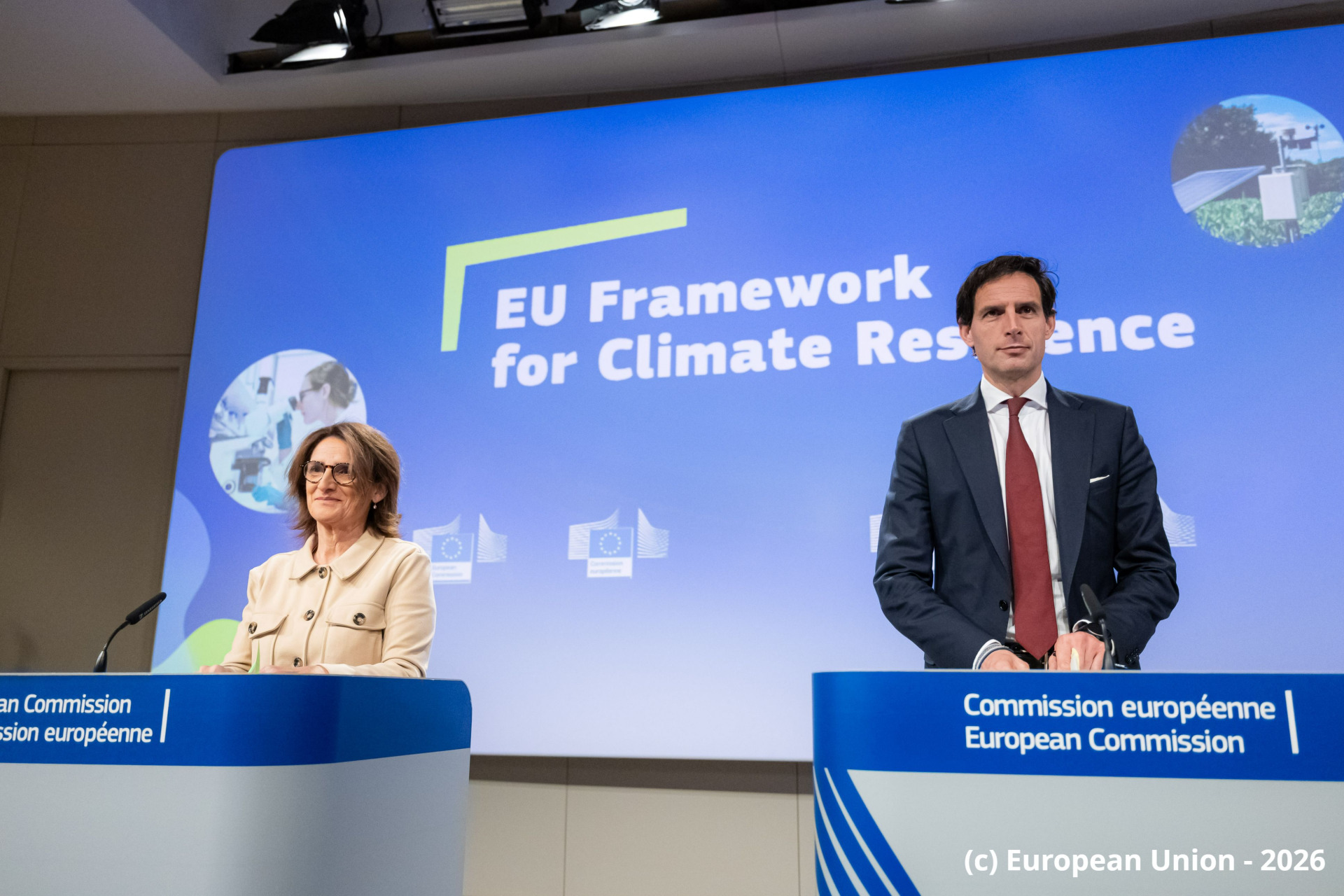
EU unveils Climate Resilience Framework, spotlighting growing market for adaptation technologies
Share this page
By Rosita Zilli, Policy Director, and Clara Vullo, Policy Officer
On 27 October, the European Commission presented a package aimed at strengthening Europe's preparedness and resilience to the growing impacts of climate change. The package includes a Communication presenting an EU Framework for Climate Resilience and a proposal for a Climate Resilience Law. These initiatives, announced in the Commission's 2026 Work Programme, come after a summer of prolonged heatwaves, droughts and devastating wildfires, highlighting the serious consequences of climate change for citizens, businesses and infrastructure. The package reflects the need to complement efforts to reduce greenhouse gas emissions with stronger measures to prepare for climate impacts that are already occurring.
The Framework Communication proposes to embed climate resilience across major policy areas, both domestic and international, promoting a more systemic approach. It sets out a common European framework for managing growing climate risks and integrating resilience into policymaking and economic and investment decisions over the longer term. The Framework aims to enable Member States to share knowledge, pool expertise and improve coordination, supported by new practical tools: the European Climate Viewer, the Navigator of Climate Resilience Tools and the Mission Solutions Explorer.
The Communication also emphasises the need for stronger investment and innovation. Adapting Europe's infrastructure and economy to future climatic conditions is expected to require investment of around €70 billion per year, while the Commission stresses that the estimated return on climate adaptation investments can reach more than ten times their value in avoided losses and damage. It therefore makes the case for Member States to use state aid to encourage private investment, noting that the market for climate resilience technologies is projected to quadruple to €3.5 trillion by 2050. The Commission's document also recognises the role of EU-funded research and innovation in advancing knowledge and developing innovative solutions and technologies. In particular, it highlights Horizon Europe's contribution to longer-term competitiveness in climate resilience solutions by supporting R&I leading to new technologies and services, including, where appropriate, through European Partnerships as a vehicle to contribute to climate resilience objectives.
The proposed Climate Resilience Law provides common reference warming scenarios to be used by Member States as a baseline for assessing future climate risks when making decisions. Governments would be required to prepare for scenarios of 2°C warming by 2050 and 3°C by the end of the century, reflecting the risks associated with current global warming trajectories. The Commission has stressed that this does not imply abandoning the objective of limiting global warming to 1.5°C, but rather recognising the need to prepare for potentially more severe climate impacts.
Under the proposal, Member States would carry out national climate risk assessmentsevery five years starting in 2029 and subsequently draw up climate resilience plans by the end of 2030. The aim is to establish a single strategic plan allowing Member States to meet their planning obligations under the Climate Resilience Law and the European Climate Law, streamlining planning and progress reviews. These strategies would also identify the public authorities responsible for managing specific climate risks, ensuring clearer allocation of responsibilities.
Critical energy systems are among the sectors to be assessed for climate-related risks at national and potentially subnational level under the proposed law. The Framework Communication also indicates that the forthcoming revision of the EU's energy security framework could refer to the same warming scenarios and integrate climate resilience by design. The Commission also confirmed plans to present a new EU Action Plan for Energy-Efficient Cooling and Heating in 2027 to support action in heat-prone urban areas.
The European Commission is set to begin implementing the Climate Resilience Framework immediately. As announced by President von der Leyen in her State of the Union address, the Commission will further strengthen Europe's capacity to prepare for and respond to climate extremes through additional initiatives, including an EU strategic plan on climate resilience expected in 2028. The European Environment Agency is also tasked with preparing EU-wide climate risk assessments, with the next one expected in June 2028.
EERA welcomes these developments, having already advocated for placing resilience at the centre of policy discussions in its 2025 position paper, Resilience and preparedness in Europe's energy transition: the role of low-carbon energy R&I. In particular, EERA calls for resilience and preparedness to become foundational principles of Europe's energy transition, with low-carbon energy R&I serving as a strategic lever to achieve this transformation, turning vulnerability into innovation and uncertainty into opportunity. EERA will continue working towards these objectives, including through its recently established transversal Joint Programme on Energy Security and Resilience.
Login as an EERA member
In case you are an EERA member and don’t have login details, please contact secretariat@eera-set.eu
Join EERA
You are not an EERA member yet? Then you are missing out on a lot!
EERA gathers the best energy researchers and infrastructures in the whole of Europe
EERA makes your voice heard in the political discussions at the European level
EERA offers great networking opportunities with peers from your discipline - and others