State of the Union: Europe’s independence moment turns to delivery
Share this page
By Rosita Zilli, Policy Director, and Clara Vullo, Policy Officer
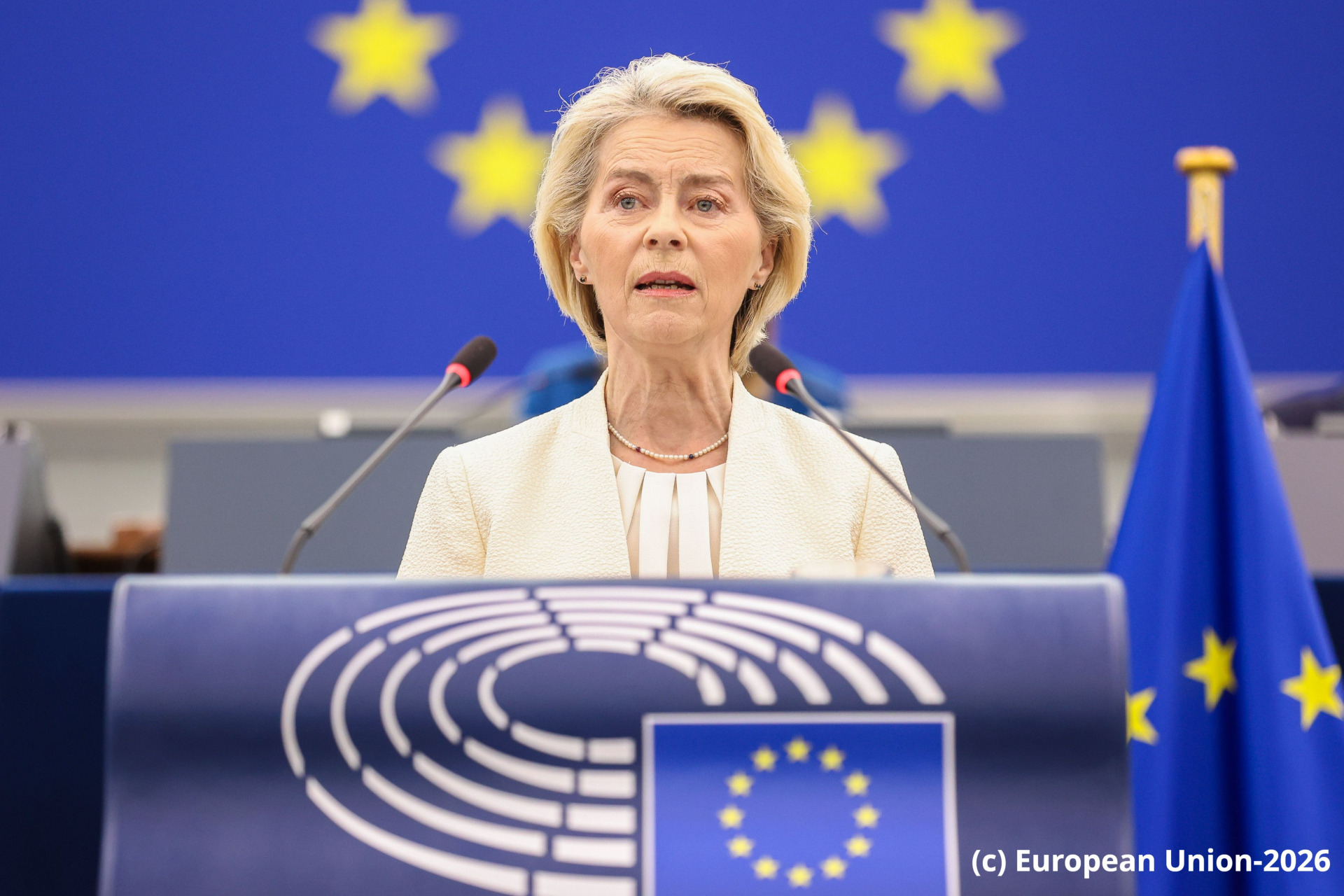
“It was the best of times, it was the worst of times.” European Commission President Ursula von der Leyen opened her 2026 State of the Union address on 16 September by borrowing from Dickens to describe a Europe that, in her telling, is stronger than ever and yet navigating an increasingly precarious world. The political thread running through the speech was clear: building a more independent Europe with the power to act in a world of growing geopolitical, economic and technological competition.
Competitiveness, security, industrial capacity and strategic dependencies were all woven into this ambition. Energy featured prominently as a condition for Europe’s independence and prosperity, while research and innovation, though less visible as a standalone theme, emerged as an enabler of Europe’s ability to develop, scale and deploy strategic technologies.
The link between energy and independence was particularly direct. Von der Leyen warned that Europe cannot remain an industrial powerhouse with structurally high energy prices. Russia’s gas cuts had already exposed the risks of dependence and the closure of the Strait of Hormuz brought them sharply back into focus. Since the start of the conflict in the Strait, she said, Europe has spent an additional €90 billion on imported fossil fuels, representing a stark illustration of the economic cost of continued dependence on external energy supplies.
Against this backdrop, she called for more affordable, home-grown clean energy, citing renewables, nuclear and biomethane as part of a technologically neutral approach. Electrification was central to this: “For this independence, we need to electrify Europe”, she said, reiterating the objective of doubling the share of electricity by 2040 — set as an indicative target in the July Electrification Action Plan — which the Commission estimates could cut Europe’s fossil-fuel import bill by €260 billion a year.
The Commission President immediately linked greater electrification to the ability of the energy system to deliver it. Europe installed more than 80 GW of renewable capacity last year, while six times as much is waiting for a grid connection. “What a waste,” she said, calling for faster investment and grid connections, more storage and the forthcoming Grids Package. Electrification on the scale envisaged will require an energy system capable of integrating, storing and delivering much more electricity.
The push to turn technological capabilities into economic and industrial strength extended across the wider competitiveness agenda. Von der Leyen highlighted Horizon funding, private investment and the Scaleup Europe Fund, while AI was discussed largely in terms of application, with energy grids among the sectors identified for deployment. She also returned to the Draghi and Letta agendas and a more integrated Single Market, including through the “One Europe, One Market” roadmap and efforts to remove barriers to the movement of energy, capital and innovation.
Climate resilience received greater prominence too. Calling the past summer a “summer of truth” after record heatwaves, fires and low river levels, von der Leyen put adaptation much closer to the centre of the agenda. A new climate resilience framework, Climate Insurance Alliance, European Heatwave Plan and European Water Initiative are ahead, alongside an ambition for European leadership in adaptation technologies.
Critical raw materials brought the question of strategic dependence back to the fore. Von der Leyen announced a European Corporation on Critical Raw Materials to support procurement and stockpiling for value chains including batteries, semiconductors and clean technologies. For the energy transition, reducing these dependencies will also require European capabilities across processing, recycling, circularity and material substitution. The question is not simply whether Europe can access the technologies and materials it needs, but how much of the knowledge and industrial capacity underpinning them it can develop and retain.
Greater independence does not, however, mean turning inwards. With Canadian Prime Minister Mark Carney in Strasbourg, von der Leyen proposed an EU-Canada “Alliance for the Future” spanning technology, energy, critical minerals and AI, and opened the door to Canada becoming the EU’s first “associate member”. It was the clearest example in the speech of what she described as a need to “reimagine” Europe’s partnerships — reducing vulnerabilities while building new forms of cooperation around shared economic and strategic interests.
The State of the Union provides a clear indication of the political direction Europe is likely to pursue in the years ahead and, with it, an important reference point for EERA’s policy and advocacy work. For energy R&I, the speech reinforces a shift already visible in EU policy: greater attention to demonstration, scale-up, deployment and the industrial capacity needed to bring technologies into use. For EERA, this makes it all the more important to ensure that this stronger downstream focus is matched by sustained investment in the research and technological development on which it depends. Maintaining a strong continuum from research to deployment will be particularly important as the EU’s post-2027 R&I and competitiveness framework takes shape.
This will also be the political backdrop to EERA’s High-Level Policy Conference on 14 October, “Europe’s triple challenge, one answer: Research-driven clean energy transition for decarbonisation, security and competitiveness,” putting R&I at the centre of the debate on how Europe turns its clean energy transition into a source of strength and its ambitions into the capacity to deliver.
Login as an EERA member
In case you are an EERA member and don’t have login details, please contact secretariat@eera-set.eu
Join EERA
You are not an EERA member yet? Then you are missing out on a lot!
EERA gathers the best energy researchers and infrastructures in the whole of Europe
EERA makes your voice heard in the political discussions at the European level
EERA offers great networking opportunities with peers from your discipline - and others