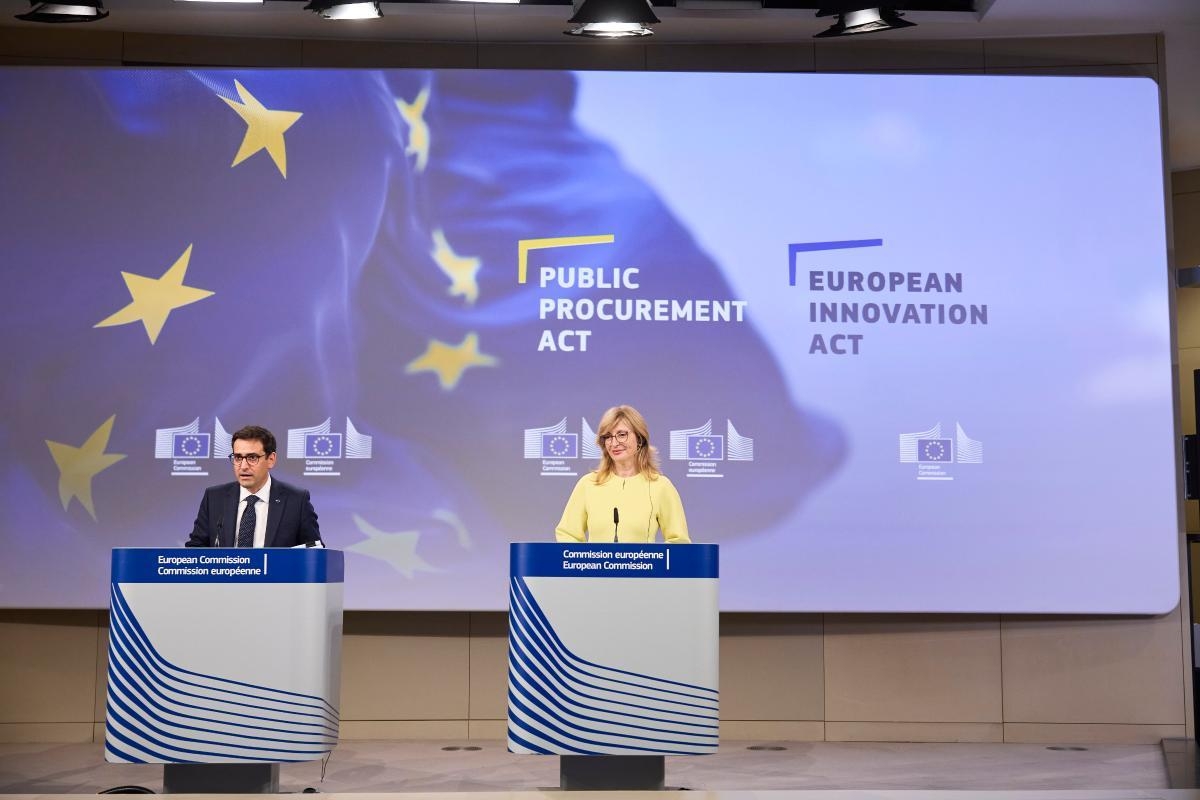
The EIA targets in particular two obstacles to bringing innovation to market: access to finance and the limited use of public procurement to support R&D. On finance, innovative companies may own valuable patents and other intellectual property (IP), but investors and banks often find it difficult to determine how much these assets are worth and therefore how far they can be relied on when providing financing. The EIA proposes a common EU framework for IP valuation, alongside an EU-wide marketplace for commercialising IP and an advisory centre to help companies value their intellectual property and use it to access finance. The Commission estimates that these measures could unlock €10.2 billion per year in additional financing.
The second focus is R&D procurement — using public purchasing power to commission the development and testing of solutions that are not yet available on the market. The EIA would establish a common EU procedure and make it easier for public buyers from different Member States to procure R&D jointly. The policy objective goes beyond simplifying procurement, as the aim is to use public demand to stimulate the development of new technologies and give innovative solutions an early route towards the market.
Alongside the Act, the Commission proposed common EU principles for regulatory sandboxes, which allow innovators to test new technologies, products or services for a limited period under the supervision of regulators. Sandboxes already exist in some sectors and Member States, while the proposed Recommendation would establish a common set of principles for creating and operating them in areas where no specific EU framework currently exists, reducing fragmentation and making this form of regulatory experimentation easier to use across Europe.
A JRC analysis underpinning the impact assessment estimates that the Innovation Act could generate up to €452 billion in cumulative EU GDP and around 500,000 jobs over ten years. Improved IP valuation is expected to generate the largest gains, while R&D procurement is identified as the second major driver. The analysis estimates that every €1 spent on R&D procurement could generate around €3 in returns for participating companies, as the R&D undertaken helps them develop technologies, build know-how and improve production processes.
On procurement, the EIA also complements the Commission’s broader Public Procurement Act proposal, presented on the same day. While the EIA focuses on public procurement of R&D to develop solutions that are not yet on the market, the wider reform would also make it possible to combine the development of an innovative solution with its subsequent purchase, helping bridge the next step from R&D towards market deployment.
The EIA and Public Procurement Act will now be considered by the European Parliament and Council, while the regulatory sandboxes Recommendation will be considered by the Council. Discussions on the EIA are already starting in the Council’s Research Working Party.
The EIA and related initiatives confirm a broader shift in EU innovation policy: alongside funding R&I, greater emphasis is being placed on creating the conditions for research results to reach the market through access to capital, early public demand and opportunities to test innovative solutions in an appropriate regulatory environment. This direction has increasingly been reflected across several strands of EERA’s work and will remain an important area of engagement as the proposals move forward, so that the low-carbon energy R&I community it represents is well positioned to contribute to and make the most of Europe’s evolving innovation framework.
Login as an EERA member
In case you are an EERA member and don’t have login details, please contact secretariat@eera-set.eu
Join EERA
You are not an EERA member yet? Then you are missing out on a lot!
EERA gathers the best energy researchers and infrastructures in the whole of Europe
EERA makes your voice heard in the political discussions at the European level
EERA offers great networking opportunities with peers from your discipline - and others