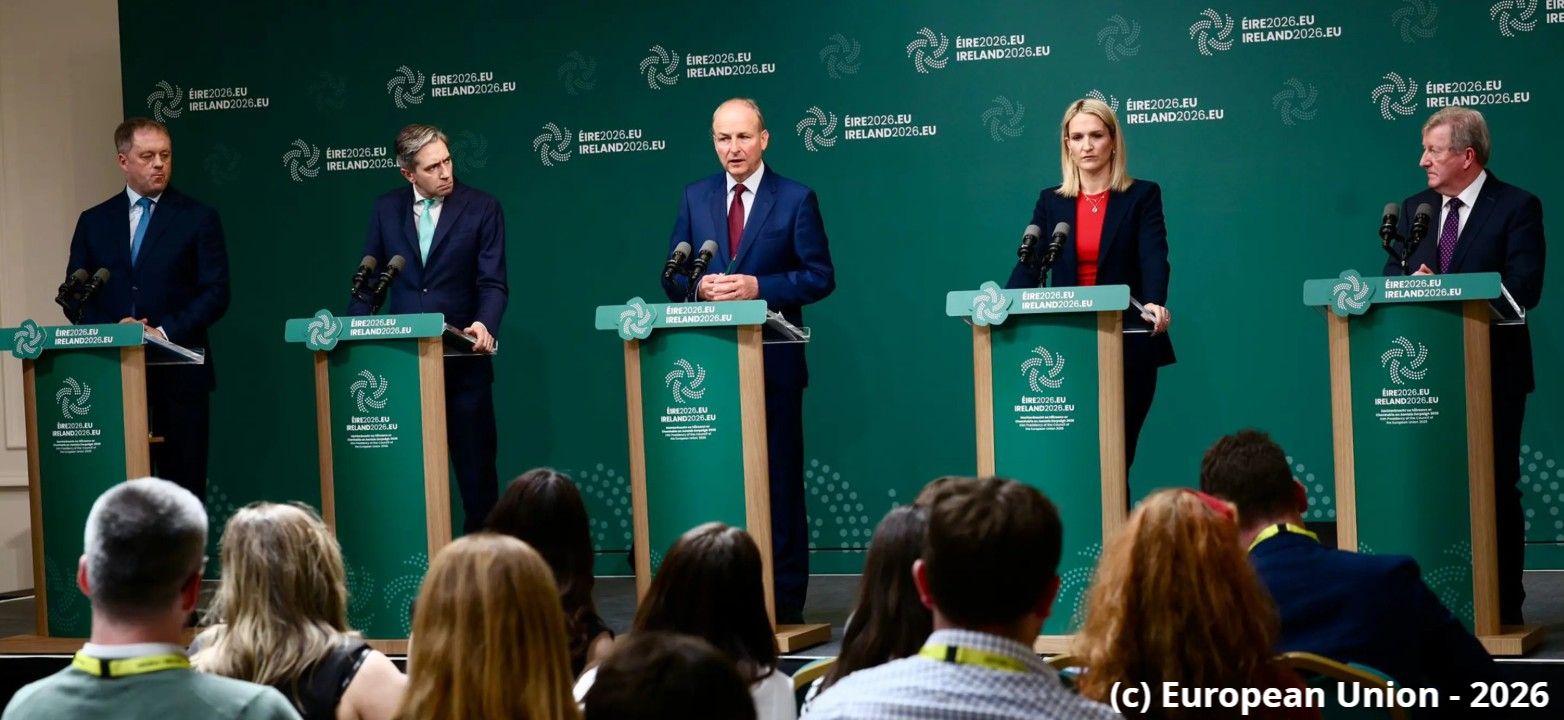
Ireland presents upcoming Presidency programme, with renewed focus on competitiveness and security
Share this page
by Rosita Zilli, Policy Director, and Marianne Lazarovici, Policy Office
On 10 June, Ireland presented its agenda for its upcoming Presidency of the Council of the European Union, running from 1 July to 31 December 2026. The programme notably underscored three core themes: competitiveness, values, and security. Within the “Competitiveness” pillar of its programme, Ireland announced its intention to focus on simplifying rules, deepening the integration of the Single Market, establishing an ambitious trade policy agenda, advancing the clean energy transition, and strengthening the EU’s digital capacities.
Amongst priorities, the Taoiseach (Irish Prime Minister), Micheál Martin, and Tánaiste (vice-Prime Minister), Simon Harris, notably highlighted work on the Multiannual Financial Framework, the EU’s seven-year budget for the 2028-2034 period. They committed to advance budget discussions to secure a modern and effective EU budget. Spanning all three pillars, reinforcing the EU’s global position by strengthening trade relationships and diversifying markets was also highlighted as a priority.
On energy, the Irish presidency committed to further foster energy security, and to support the deployment of domestic renewable and clean energy, while building robust grids, in order to develop a more electrified, resilient and efficient energy system guaranteeing energy security and affordability. Specifically, Ireland aims to deliver the European Grids Package – comprising the revised TEN-E Regulation and Permitting Directive – and progress on the proposal on Energy Taxation and Network Charges and on the Energy Security Framework – ensuring that protection and resilience of energy infrastructure, including subsea cables, remains high on the agenda.
According to the programme, in parallel, the Irish Presidency will continue supporting the implementation of the REPowerEU Roadmap, to further phase out Russian energy imports. In addition, Ireland highlighted the role of the Connecting Europe Facility programme, which supports the development of infrastructure across Europe, as well as of achieving the EU’s 2030 climate goals. Lastly, during its six months at the head of the Council, Ireland will progress work on nuclear safety and decommissioning of nuclear power plants, and on the forthcoming Energy Products Simplification Omnibus.
On research and innovation (R&I), the Irish Presidency recalls the Draghi and Letta reports, and the importance of R&I for “productivity, competitiveness, and broader social, environmental, and cultural progress”, and its value in addressing strategic challenges, thus committing to advancing negotiations pertaining to Framework Programme 10, EU Innovation act and European Research Area Act. In parallel, the Competitiveness Council should advance work on EU Inc. (the 28th Regime for innovative companies) and the Industrial Accelerator Act, while supporting energy intensive industries also appears as a central pillar of its work. Specifically, Ireland will progress on a reform of public procurement rules, notably encouraging diversification to reduce dependencies, and fostering emerging technologies. The country also pledges integrating competitiveness with sustainability, thereby promoting upskilling and lifelong learning in the context of the twin digital and green transitions.
Lastly, the Environment Council’s agenda will focus on the fight against climate change, and on the shift to a climate neutral society by 2050, through work on climate resilience, such as on the European Climate Resilience and Risk Management Integrated Framework. In that regard, Ireland notably highlighted the importance of supporting a just transition, as well as coherent and science-based decision-making. Specifically, the Irish Presidency will progress work on the review of the EU’s Emission Trading System (ETS), the revision of the Carbon Border Adjustment Mechanism (CBAM), and the implementation of the 2040 emissions reduction target. Besides, Ireland also sets out to coordinate EU leadership at the United Nations’ COP31, by adopting Council Conclusions setting out the EU’s negotiation mandate for the conference.
Throughout the second half of the year, EERA will support its community in navigating these institutional and legislative developments, while ensuring the recognition of the role of research and innovation, as well as of the clean energy transition in ensuring EU competitiveness and security.
Login as an EERA member
In case you are an EERA member and don’t have login details, please contact secretariat@eera-set.eu
Join EERA
You are not an EERA member yet? Then you are missing out on a lot!
EERA gathers the best energy researchers and infrastructures in the whole of Europe
EERA makes your voice heard in the political discussions at the European level
EERA offers great networking opportunities with peers from your discipline - and others