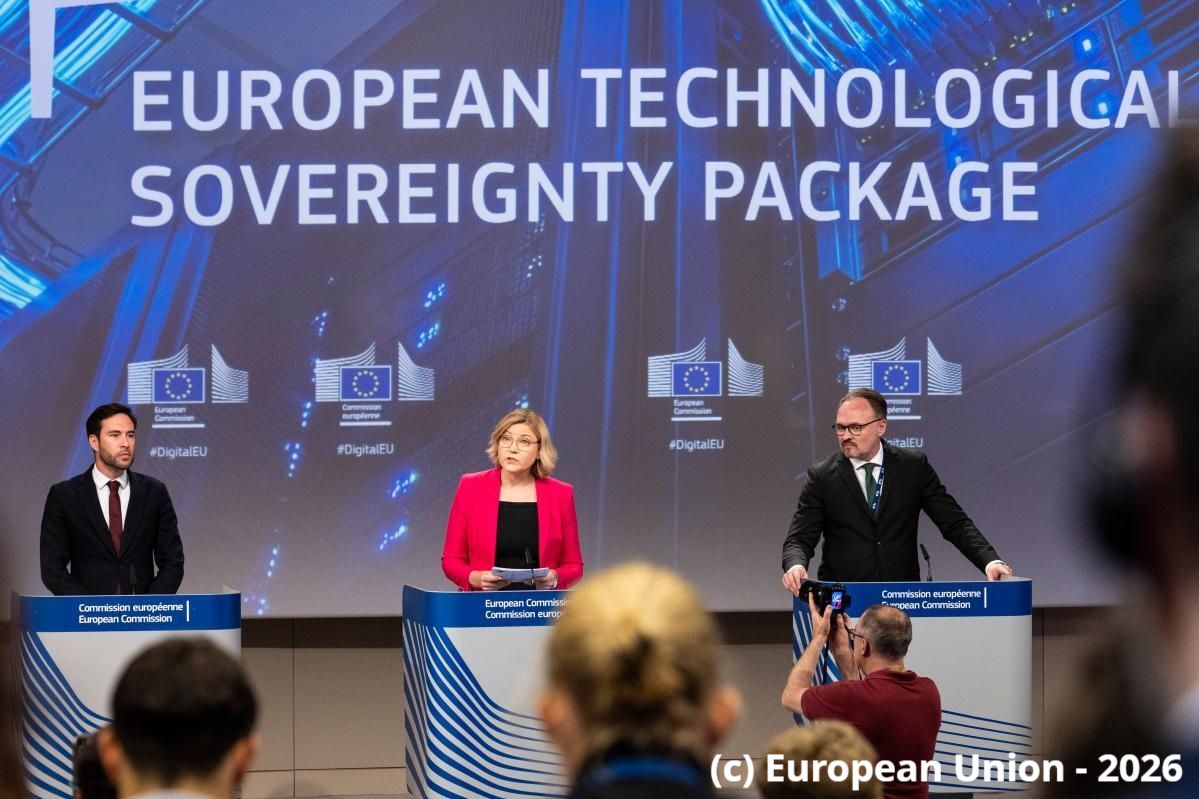
EU Commission presents European Technological Sovereignty Package, including roadmap for energy sector digitalisation and AI
Share this page
by Rosita Zilli, Policy Director, and Marianne Lazarovici, Policy Office
On 3 June, after several delays, the European Commission presented its European Technological Sovereignty Package, a series of measures aiming to strengthen Europe’s control over key technologies, such as semiconductors, artificial intelligence (AI), cloud computing and open-source technologies. According to the EU executive, the EU currently relies on non-EU countries for over 80% of key digital products, services, infrastructure, and intellectual property. As part of the package, the Commission has published a Strategic Roadmap for Digitalisation and AI in the Energy Sector, as well as proposed the Chips Act 2.0, alongside the Cloud and AI Development Act, and an Open Source Strategy, which should contribute to enhance the bloc’s digital competitiveness, resilience, and strategic autonomy.
Particularly, the Strategic Roadmap for Digitalisation and AI in the Energy Sectorseeks to speed up the adoption of digital and AI technologies across the energy system, and is structured around three main pillars: integrating data centres in the energy system, supporting the rollout of AI and digital solutions such as smart meters and grid-enhancing technologies, as well as building a framework for sharing data across EU borders. To sustainably integrate data centres into the energy system, the Commission notably proposes a model tripartite agreement, to be used between data centre operators, energy-related parties and public authorities, which could, for instance, inform grid planning or support the recovery and use of waste heat. A declaration of intent was signed in that regard by industry stakeholders.
The second pillar of the roadmap presents additional initiatives, complementing the EU Grids Package introduced in December, such as the development of a catalogue of key performance indicators for smart grids, to be finalised by mid-2026, and a legislative proposal to accelerate the rollout of smart meters in the EU. In addition, the Commission has launched AI.grid, a Community of Practice for developing AI models for grid management and planning, and will support the use of generative AI technologies to streamline permit review for renewable energy, storage and grid projects. When it comes to research and innovation, Horizon Europe will provide around €75 million for AI technologies in energy across 2026 and 2027, on projects related to grids, self-consumption, energy sharing and grid-scale storage. A further €190 million will target broader digital solutions in renewables, building renovation and energy efficiency.
Lastly, the roadmap seeks to establish an EU framework for simplified cross-border energy data exchange for smart energy services and AI model training. It will enhance interoperability for both primary and secondary use of energy data, increase efficiency and predictability. The roadmap also aims at strengthening the safety of AI and the cybersecurity of critical devices, including through AI regulatory sandboxes for testing and validation of energy AI applications. This should foster innovation and contribute to evidence-based regulatory learning on high-risk AI systems. Moreover, the Commission will request the Commission’s European Group on Ethics in Science and New Technologies to provide an opinion on the trustworthy and responsible governance of AI in the EU energy system. Concretely, the EU Commission will conduct a risk assessment of solar installations in the EU in 2026, as well as a review of the energy security of supply framework in 2026. In parallel, the Strategy also advocates to boost digital skills and promote international cooperation in the sector. Besides, to track digitalisation progress, the EU Commission will also launch an annual Energy Digitalisation Forum from 2026, alongside a Better Energy Data initiative, mapping and addressing gaps in energy data availability.
The legislative proposals part of the Package will be negotiated by the European Parliament and the Council of the European Union before their adoption and subsequent entry into force. In parallel, the European Commission is also expected to launch a call for AI Gigafactories in July. EERA welcomes the Strategic Roadmap as an important step forward and sees its own expert recommendations reflected in several of its priorities. In its 2025 publication “Unlocking the power of AI in Europe's energy systems”, EERA called for a dedicated EU AI in Energy Mission Board to coordinate funding and align actors across research, policy and industry; a common European energy data space built on shared standards that prevent vendor lock-in; and sustained investment in skills and public trust, without which no technology succeeds at scale. As the Roadmap moves into implementation, EERA will continue to engage with its development, drawing on these expert recommendations to ensure that research institutions remain central actors in Europe's AI-enabled energy transition.
Login as an EERA member
In case you are an EERA member and don’t have login details, please contact secretariat@eera-set.eu
Join EERA
You are not an EERA member yet? Then you are missing out on a lot!
EERA gathers the best energy researchers and infrastructures in the whole of Europe
EERA makes your voice heard in the political discussions at the European level
EERA offers great networking opportunities with peers from your discipline - and others