First Conference on Transitioning Away from Fossil Fuels revives hopes for coordinated global climate action amid multilateral lull
Share this page
by Rosita Zilli, Policy Director, and Marianne Lazarovici, Policy Officer
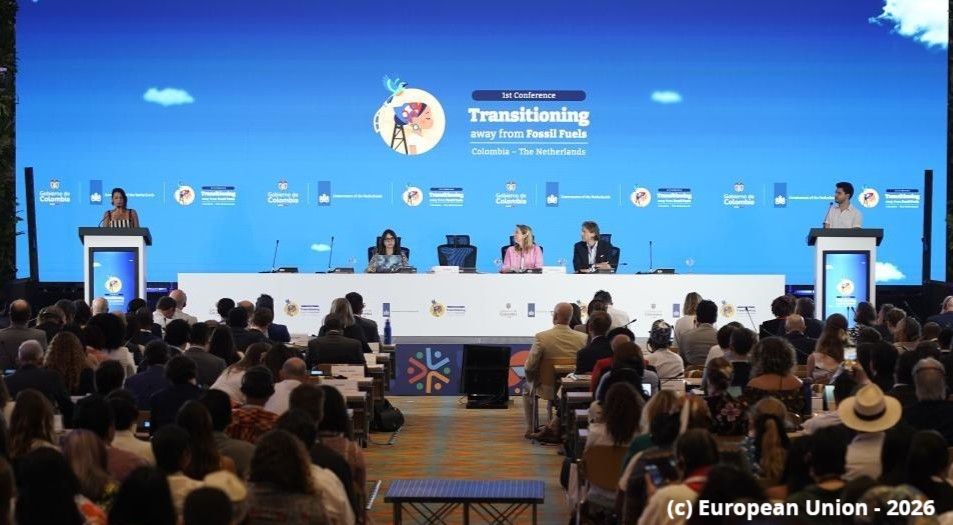
On 28 and 29 April, 57 countries met for the first-ever Conference on Transitioning Away from Fossil Fuels (TAFF) in Santa Marta, Colombia to discuss how to advance the clean energy transition. The conference, co-hosted by Colombia and the Netherlands, took place seven months before the United Nations’ flagship climate change conference, COP31, in Antalya, Turkey, as many see climate multilateralism coming under strain.
The conference gathered a wide array of nations, both fossil fuels producers and importers, which had recognised the need to phase out fossil fuels. This ‘coalition of the willing’ format – with countries such as the United States, Russia and China notably absent – allowed for constructive discussions and prevented deadlocks, which frequently happen in UN fora. However, the countries gathered only represented about 15% of the world’s total fossil fuel production. Still, several important oil and gas producers were in attendance – including Canada, Australia, Brazil, Mexico, Norway and Nigeria, whose combined production is still on the rise.
Nonetheless, the conference sent an important signal, highlighting that fossil fuel dependence, in the current context, characterised by war in the Middle East and extreme energy price volatility, constitutes an economic and security vulnerability, in addition to the climate risks it carries. Furthermore, it demonstrates a strong willingness to move forward, after the COP30 Climate summit in Brazil, where progress was arguably limited. The TAFF conference also offered a stark contrast with the meeting of G7 nations on the environment taking place on 23 April in Paris, where climate change was completely left off the agenda, notably to avoid a spat with the United States – a decision which was heavily criticised by environmental and climate activists.
While the TAFF conference ended without a formal negotiated outcome, several follow-up steps were agreed, including the creation of a voluntary steering committee - a group of countries tasked to move discussions forward – and the launch of a Science Panel for the Global Energy Transition (SPGET). Specifically, these instances are set to work on establishing national and regional roadmaps to transition away from fossil fuels, connected to the UN’s Nationally Determined Contributions climate commitments, and offering a path towards fossil-free trade systems, as well as looking at how to leverage the financial system.
A conference report will notably be circulated at the UN’s New York Climate Week in September 2026, and a follow-up conference will take place in 2027 in Tuvalu – a small Pacific island nation which could disappear by the end of the century due to rising sea levels – and co-hosted by Ireland.
EERA, which advocates for ensuring a sustainable and resilient European energy system, in line with planetary boundaries, will continue to monitor the development of global and European climate talks, and will keep advocating for a swift clean energy transition, and for the recognition of the role of research and innovation in accomplishing it.
Login as an EERA member
In case you are an EERA member and don’t have login details, please contact secretariat@eera-set.eu
Join EERA
You are not an EERA member yet? Then you are missing out on a lot!
EERA gathers the best energy researchers and infrastructures in the whole of Europe
EERA makes your voice heard in the political discussions at the European level
EERA offers great networking opportunities with peers from your discipline - and others