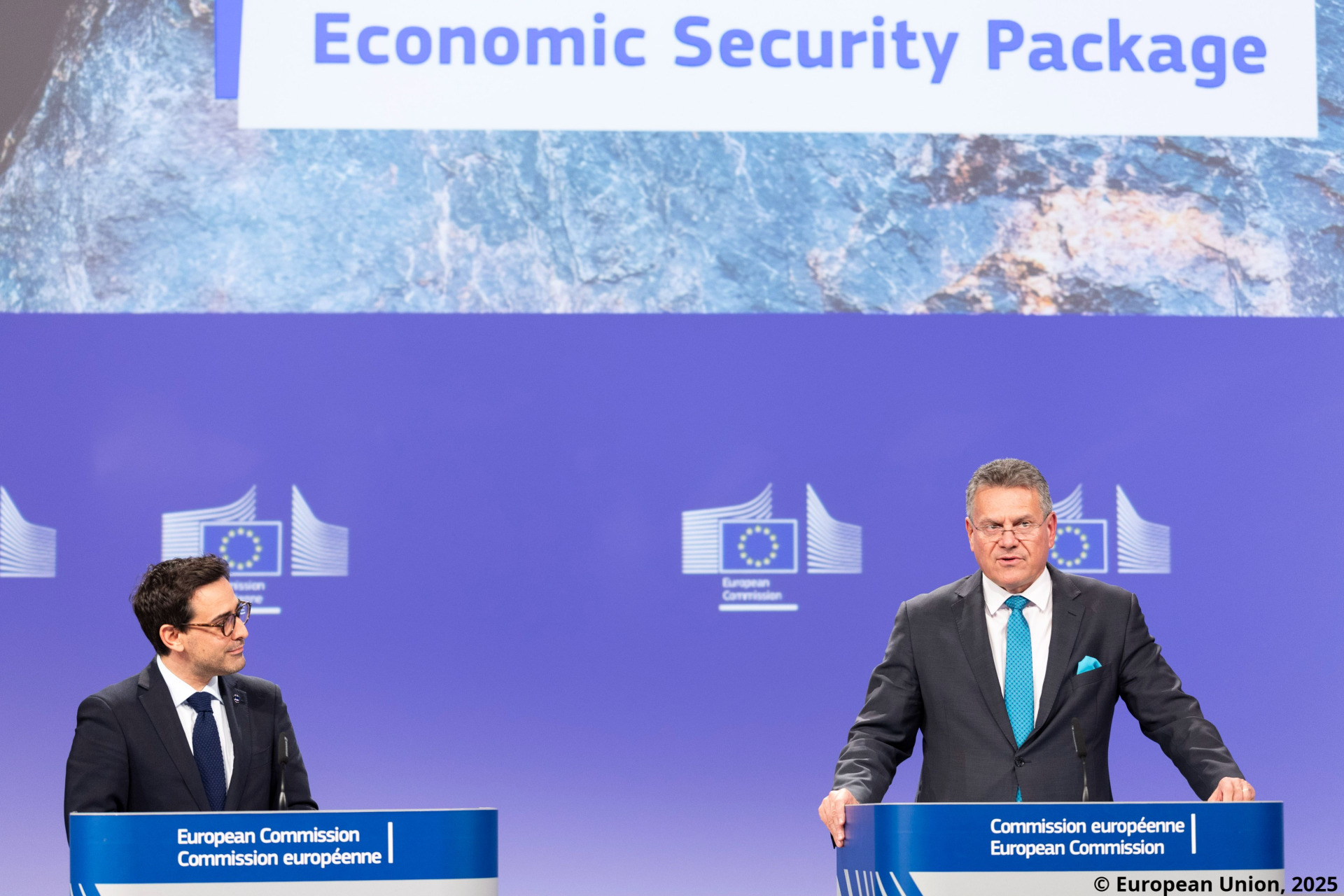
EU Commission’s new plan to boost domestic critical raw materials value chains highlights key role of R&I in production, recycling and substitution
Share this page
On 3 December, the European Commission adopted the RESourceEU Action Plan aiming at accelerating efforts to secure the Union’s supply of critical raw materials (CRMs). The Plan builds on the Critical Raw Materials Act (CRMA), first introduced in 2022, and which set ambitious benchmarks for domestic CRM capacity along the entire supply chain – 10% of the EU's annual needs for extraction; 40% for processing and 25% for recycling – to be reached by 2030. Providing concrete measures to further reduce the EU’s strategic dependencies, it comes in a tense geopolitical context where China, which dominates the majority of the supply chains for a large number of materials, continues to ramp us export control measures. As the global rivalry for resources intensifies, securing key minerals while reducing the EU’s dependencies remains essential for the EU’s defence, clean technologies and digital industries.
The creation of a European Critical Raw Materials Centre, providing market intelligence and bringing together private and public partners to support strategic projects, is one of the initiative’s main proposals, alongside the creation of a Raw Materials Platform. The objective of the latter is notably to aggregate demand and facilitate the joint purchase of strategic raw materials. In parallel, EU Member States are working on developing a coordinated EU approach to stockpiling critical raw materials, with a pilot scheme expected in early 2026.
In addition, the Plan announces measures to strengthen monitoring, crisis coordination and defence against hostile interference, as well as the introduction of new restrictions on the export of scrap and waste of permanent magnets and targeted measures on aluminium scrap early next year, to be potentially followed by further measures on copper scrap in order to improve recycling capacities. Similarly, a targeted amendment to the CRMA will contribute to the expansion of product labelling requirements to further strengthen recycling incentives.
When it comes to financing, the Action Plan only presents limited updates, highlighting the key role already played by the Savings and Investments Union, the Innovation Fund, the Just Transition Fund and the European Investment Bank. However, a new CRM financing hub will be created to coordinate funding support. In addition, the Battery Booster strategy, to be presented next week, will include a €1.8 billion envelope to fund CRM projects related to the battery value chain. Overall, the Commission estimates that the EU will mobilise around €3 billion over the next twelve months to support CRM projects. In parallel, it assesses that the 60 Strategic Projects approved under the CRMA this year will need to mobilise around €2.15 billion to meet their estimated financial needs.
Research and innovation is also highlighted as important tools for improving the European CRM value chain – from extraction, to processing and recycling, as well as substitution. The Action Plan states that the Commission will launch dedicated calls under Horizon Europe’s 2026–2027 work programme worth €593 million. In addition, the European Innovation Council (EIC), the European Defence Fund and the Important Projects of Common European Interest instrument will also contribute to further supporting critical raw materials innovation.
Lastly, the European Commission intends to deepen cooperation with like-minded partners, building on the existing 15 Strategic Partnerships on raw materials signed since 2021, and has recently launched bilateral negotiations with Brazil. The EU is also working on dedicated investment frameworks for integrated critical raw materials value chains with Ukraine, Western Balkan and Southern Neighbourhood countries. When presenting the Plan, EU Commission Executive Vice-President Stéphane Séjourné supported the package of measures encouraging diversification, but declared that if they fell short, the Commission could consider making such efforts “mandatory” for companies via a future delegated act.
Login as an EERA member
In case you are an EERA member and don’t have login details, please contact secretariat@eera-set.eu
Join EERA
You are not an EERA member yet? Then you are missing out on a lot!
EERA gathers the best energy researchers and infrastructures in the whole of Europe
EERA makes your voice heard in the political discussions at the European level
EERA offers great networking opportunities with peers from your discipline - and others