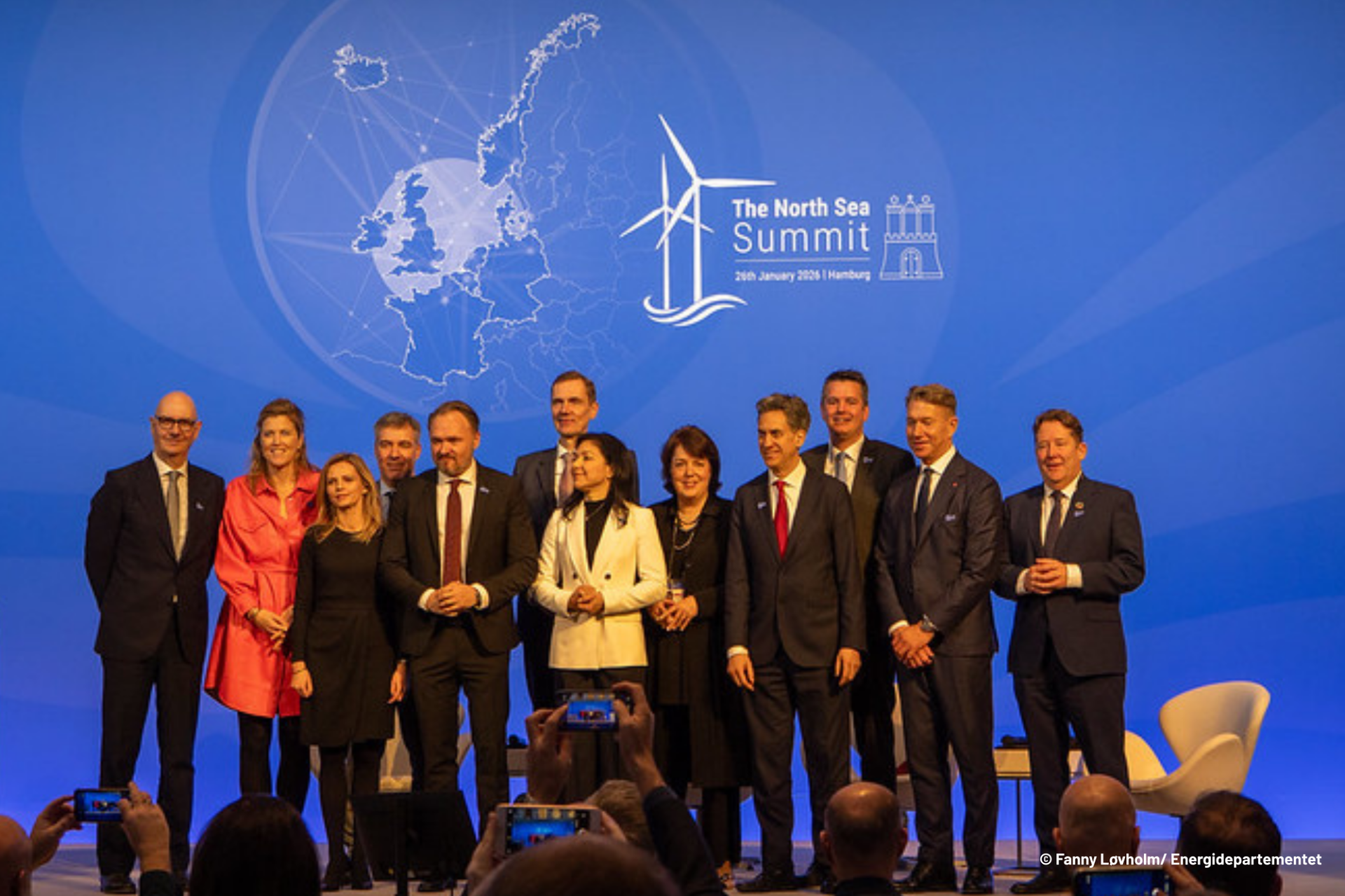
Top story of the week: Europe takes further steps towards energy independence at North Sea Summit as countries pledge to increase offshore wind capacity
Share this page
by Rosita Zilli, Policy Director, and Marianne Lazarovici, Policy Officer
The ministers of nine European countries – Belgium, Denmark, Germany, France, the United Kingdom, Ireland, Luxembourg, the Netherlands, and Norway – meeting at the North Sea Summit in Hamburg, Germany, on 26 January, signed new declarations to accelerate the development of offshore wind power in the region, including 100 GW of cross-border generation capacity, with the aim of reaching 300 GW of offshore wind in the North Sea by 2050.
First held in Denmark in 2022 in response to the energy crisis and the need to reduce dependence on Russian fossil fuels following the war in Ukraine, the third edition of the summit took place against abackdrop of renewed geopolitical tensions, particularly with the United States. With the return of Donald Trump to the White House, EU–US relations have cooled, lately raising concerns that increased reliance on US liquefied natural gas (LNG) could create a new dependency to replace that on Russian fossil fuels.
Against this backdrop, the Summit benefited from a renewed momentum, leading to the signature of several declarations, namely a Joint Offshore Wind Investment Pact for the North Seas by region’s leaders, industry and Transmission System Operators (TSOs), underpinned by a Leaders’ Declaration on building a North Seas power hub for a resilient and competitive Europe, and a Ministerial Declaration on closer coordination to accelerate offshore wind and hydrogen projects, and an Industry Declaration, signed by more than 100 companies across the offshore wind value chain.
UK Secretary of State for Energy Security and Net Zero, Ed Miliband, and EU Energy Commissioner Dan Jørgensen welcomed the progress made towards securing clean, homegrown energy and highlighted in a common editorial that relying heavily on fossil fuels was highly detrimental to Europe’s energy security and prosperity.
Governments committed to building 15 gigawatts (GW) of offshore wind per year over 2031–2040, with the ambition of reaching 300 GW of offshore wind in the North Sea by 2050, as agreed during the 2023 North Sea Summit. Participating countries had also set an intermediate target of 120 GW by 2030, which is unlikely to be met on time, as current installed offshore wind capacity across Europe totals 37 GW.
A core decision of the summit concerns strengthening cross-border planning, with 100 GW of generation capacity across borders through large-scale cooperative projects. In addition, countries agreed to foster closer cooperation, notably to exchange security-related data and secure critical infrastructure. Governments also pledged to improve planning and investment security, as well as to de-risk offshore wind projects. In turn, the wind industry pledged to reduce the levelised cost of electricity by 30% by 2040, create 91,000 additional jobs, and generate €1 trillion worth of economic activity.
EERA welcomes the outcomes of the North Sea Summit, as they signal a renewed political willingness among participating European governments to design coordinated and low-carbon energy systems, reduce strategic vulnerabilities, and align industrial ambition with long-term climate and security objectives, providing a clearer reference point for forthcoming energy policy and investment discussions.
Login as an EERA member
In case you are an EERA member and don’t have login details, please contact secretariat@eera-set.eu
Join EERA
You are not an EERA member yet? Then you are missing out on a lot!
EERA gathers the best energy researchers and infrastructures in the whole of Europe
EERA makes your voice heard in the political discussions at the European level
EERA offers great networking opportunities with peers from your discipline - and others