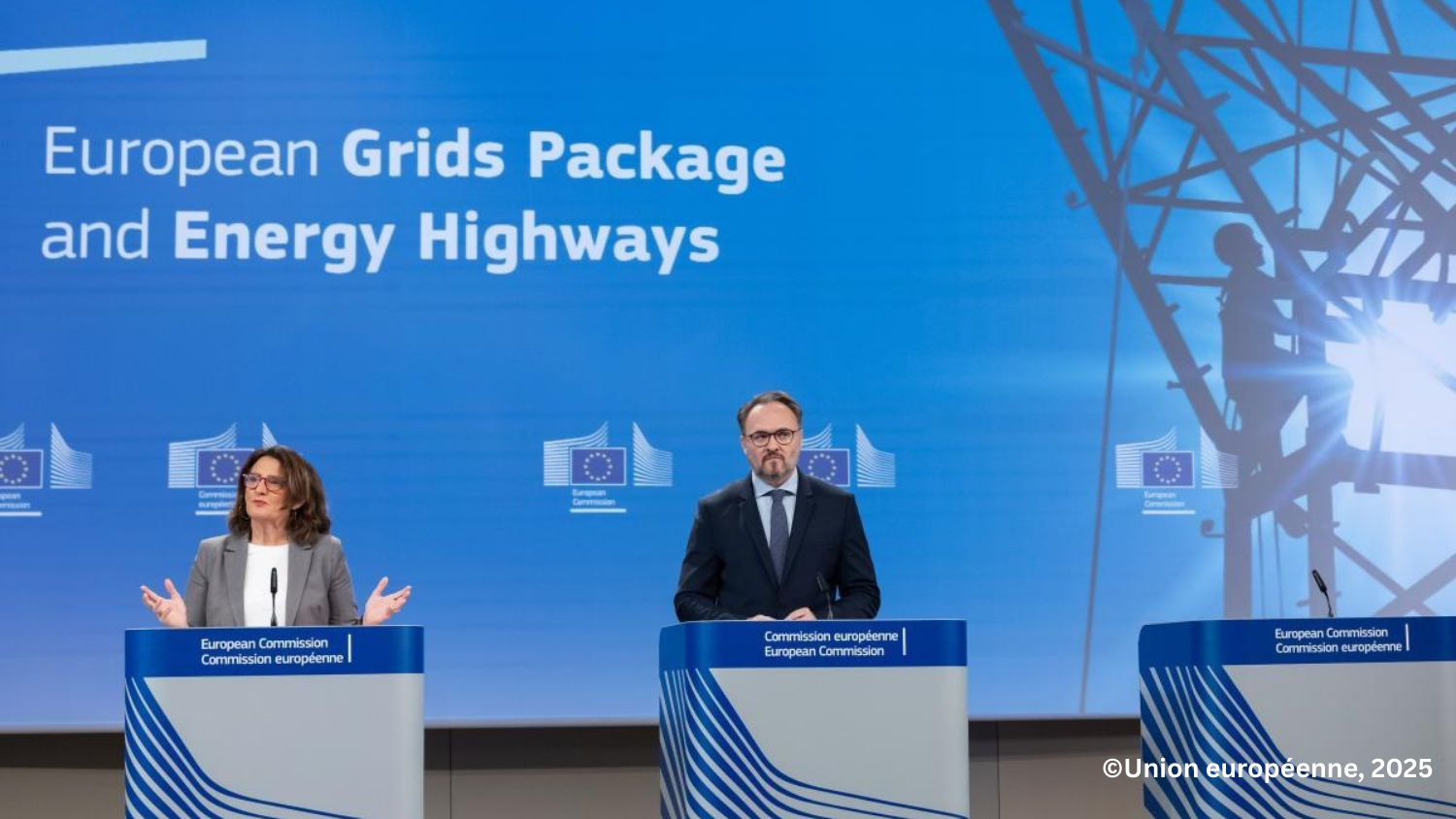
Top story of the week: New European Grids Package increases focus on EU infrastructure and coordination needs
Share this page
On 10 December, the European Commission introduced a new European Grids Package communication, alongside the Energy Highways initiative, first announced by Ursula von der Leyen in her State of the Union 2025 speech. Both initiatives intend to accelerate electrification, enhance energy flows across Europe, and boost the uptake of clean energy, with the overall objective of lowering prices and ensuring energy security and the resilience of energy infrastructure.
Aiming to create a European perspective on infrastructure planning, the Package proposes the creation of a central European energy scenario, an initiative aimed at enhancing synergies across sectors and identifying infrastructure needs, by gathering input from Member States and relevant stakeholders. In addition, together with the EU DSO Entity, the EU association of Distribution System Operators, the European Commission aims to establish a platform for EU distribution network planning, providing more visibility on future network development plans and related manufacturing needs. In parallel, the Package aims to accelerate permitting procedures and contribute to ensuring a fairer division of costs for cross-border projects, thanks to an EU-level framework and by promoting greater transparency and fairness in the way costs and benefits are assessed.
In addition, one of the EU Grids Package’s objectives is to maximise the use of existing infrastructure, notably through the uptake of smart electricity grids, innovative digital technologies and efficiency measures, which should be systematically integrated into network planning. At the same time, the European Commission’s communication also sets out to accelerate the development of grids and physical energy infrastructure more broadly, in a manner which respects biodiversity and encourages public participation. To support the latter, the Commission will notably propose a practical toolbox on public participation and engagement in the first quarter of 2026.
The Package highlights the significant financial needs of the sector, estimating that investments reaching €1.2 trillion will be needed in the EU’s electricity grids by 2040, including €730 billion for distribution grids alone. The European Commission also emphasises the need for private investment, which will be addressed in the upcoming Clean Energy Investment Strategy, whose presentation has been moved from 10 December to 16 December. In addition, the communication underscores the role of the next Multiannual Financial Framework (MFF), which includes a significantly reinforced Connecting Europe Facility (CEF), with CEF Energy benefitting from a fivefold increase, from a budget of €5.8 billion to €29.91 billion.
Following the same objectives, the Energy Highways initiative corresponds to the selection of eight projects identified as requiring short-term support, answering urgent infrastructure needs and notably having the potential to contribute to achieving the Energy Union. The list includes the Pyrenean crossings, intending to better integrate the Iberian Peninsula with France; the Great Sea Interconnector, connecting Cyprus to continental Europe; the Harmony Link project, improving the Baltic States’ integration; the Trans-Balkan Pipeline reverse flow, improving supply in the Balkan region and eastern neighbouring states; the Bornholm Energy Island in the Baltic Sea; the South Hydrogen Corridor, involving Tunisia, Italy, Austria and Germany; the Southwest Hydrogen Corridor from Portugal to Germany; and, lastly, a project focused on south-eastern Europe aimed at improving price stability and energy security.
These so-called “Energy Highways” will benefit from fast-tracking, through enhanced political coordination, as well as increased administrative and technical support from the European Commission for the Member States. For instance, the Pyrenean crossings, the Southwest Hydrogen Corridor and the south-eastern Europe project will be designated as pilots under the Competitiveness Coordination Tool, to better align national and EU priorities.
Login as an EERA member
In case you are an EERA member and don’t have login details, please contact secretariat@eera-set.eu
Join EERA
You are not an EERA member yet? Then you are missing out on a lot!
EERA gathers the best energy researchers and infrastructures in the whole of Europe
EERA makes your voice heard in the political discussions at the European level
EERA offers great networking opportunities with peers from your discipline - and others