Can Europe stay competitive? How AI, resilience and innovation hubs hold the key to Europe’s transition to low-carbon industrial leadership
Share this page
By Chiara Fort, Communications Officer EERA
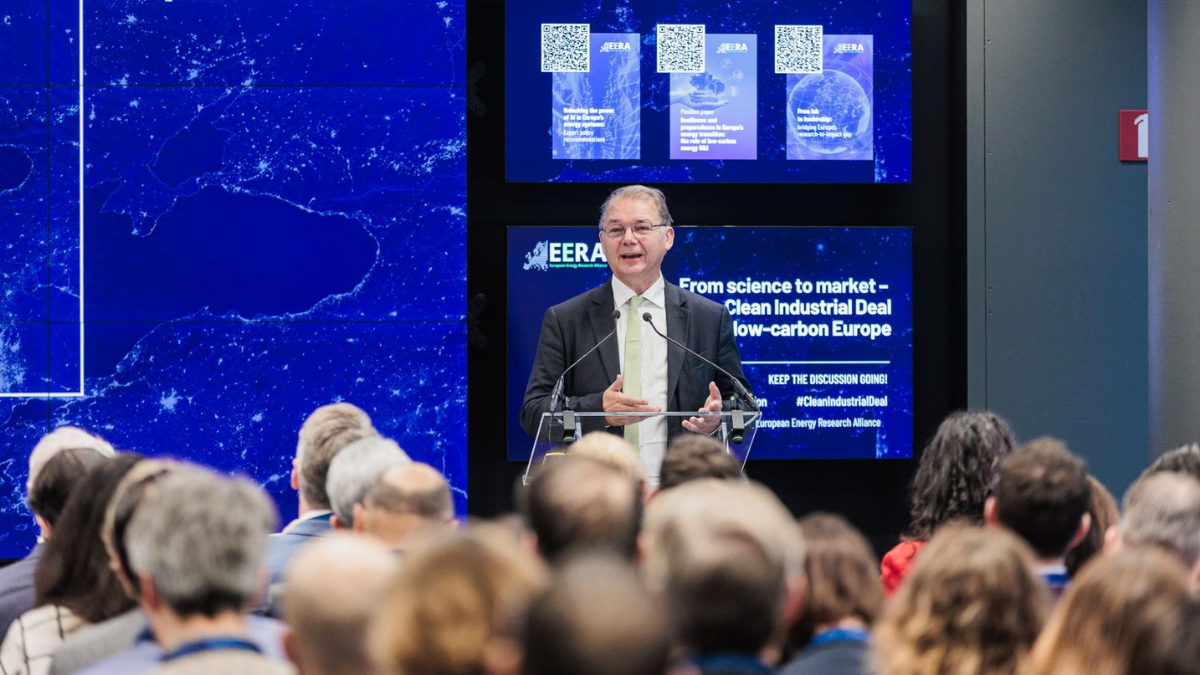
Europe’s clean energy transition has entered a new phase, one defined not only by climate ambition, but by competitiveness, resilience and strategic autonomy. This shift framed the discussions at EERA’s 2025 High-Level Policy Conference, held on 3 December in Brussels, where policymakers, researchers and industry leaders came together to address a question that is becoming central to Europe’s future: how can the Clean Industrial Deal translate scientific excellence into industrial leadership?
From the moment EERA President Henk-Jan Vink opened the conference, a sense of urgency settled across the room. Europe, he reminded participants, is entering a decisive decade in which competitiveness has become the Union’s overarching concern. While global powers scale technologies and industries at unprecedented speed, Europe struggles to grow at the same pace. In this context, low-carbon energy research and innovation stand out as essential enablers of Europe’s future leadership.
Reframing Europe’s economic choices with Phillipe Lamberts and Mariana Mazzucato
Philippe Lamberts offered one of the day’s most powerful insights. Despite Europe’s ambitions, the continent continues to rely heavily on fossil-fuel imports, exposing structural vulnerabilities that undermine competitiveness. Reducing this dependency is not simply a climate imperative, it is a prerequisite for strategic autonomy!
Mariana Mazzucato expanded this perspective by calling for a mission-oriented industrial strategy. Europe, she argued, does not suffer from a lack of financial resources but from a lack of purpose-driven deployment. Missions require clear direction, coordinated investment and governance models that align public and private actors toward shared societal goals. While her message spans all sectors, its relevance to the energy transition is unmistakable: accelerating low-carbon energy innovation requires the same coherence, ambition and public leadership. And it is precisely in this space between discovery and deployment that Europe must accelerate if it wants to stay competitive.
Bridging the research-to-impact gap
This challenge is at the heart of EERA’s position paper From Lab to Leadership: Bridging Europe’s Research-to-Impact Gap, which examines Europe’s structural innovation barriers. The report highlights how fragmented pathways, insufficient de-risking instruments and regulatory hurdles slow progress, often turning decade-long breakthroughs into missed industrial opportunities.
Speakers from the European Commission, academia and industry converged on the same conclusion: Europe must build innovation ecosystems where ideas, expertise, funding and infrastructures move together rather than sequentially. Industry voices highlighted that without predictable frameworks and simplified access to support mechanisms, even high-potential technologies risk stalling before reaching market scale.
The proposed EERA Innovation Hubs, designed as connecting platforms rather than new institutions, offer a response. They enable coordinated de-risking, stronger collaboration across sectors and smoother progression from low-TRL research to industrial deployment.
AI as a strategic enabler — if Europe can unlock it
The second pillar of the day focused on digitalisation, through the position paper Unlocking the Power of AI in Europe’s Energy Systems. While Europe is ambitious about AI, speakers painted a candid picture: data fragmentation, limited interoperability and insufficient computing capacity are slowing progress precisely where AI could deliver transformative benefits.
Yet Europe’s competitive edge will not come from replicating global AI infrastructure giants. Instead, leadership will stem from developing “the smartest models, trained on the best data,” as Julio Serrano, Applied AI Scholar at the University of Vaasa, emphasised. He and other speakers underlined that Europe’s advantage lies in building AI systems that are trustworthy, transparent and firmly aligned with European values.
The forthcoming Common European Energy Data Space, outlined by DG ENER, is set to become one of Europe’s most consequential digital governance initiatives. By enabling secure, cross-border data access without centralising data itself, it can open the door to scalable, system-oriented AI solutions across all 27 Member States.
Resilience redefined: from vulnerability to capability
Resilience is often seen as a defensive concept, but EERA’s third position paper, Resilience and Preparedness in Europe’s Energy Transition, reframes it as a strategic capability. Europe’s risk landscape is evolving: geopolitical tensions, climate extremes, cyber-physical threats and the speed of electrified systems demand a new level of readiness.
Speakers argued that resilience must be designed into Europe’s emerging clean energy system from the outset. That requires integrated governance, modernised grids, anticipatory tools, and the involvement of citizens and decentralised actors. It also requires honest recognition of Europe’s infrastructure needs. Europe cannot meet its security or climate goals with current investment levels.
EERA’s role in shaping what comes next
The day closed with a compelling call from EERA Secretary General Adel El Gammal, who reminded participants that Europe’s strength lies in its ability to collaborate across borders, disciplines and sectors. Trust, in science, in cooperation, in Europe’s capacity to act, is the foundation on which the Clean Industrial Deal must be built.
Europe has the talent and ambition to lead the global clean industrial transformation. But success will depend on coherence, speed and willingness to move fast together. EERA stands ready to support this shift, from science to market, from ambition to impact, by mobilising Europe’s research excellence to shape science-based policy and drive innovation. In doing so, we can ensure that Europe does not follow the future, but helps define it!